Sunday, July 22, 2012

Stripers


Stripers

I can’t say enough good things about Striped Bass.  I grew up near Narragansett Bay and Rhode Island’s "South County" beaches.  These are famed striper waters, but my youth corresponded to the one time in history (and post-glacial pre-history, too) when the stripers were absent from these waters.  And even if they weren’t totally physically absent (the sharpies who frequented Murat’s Tackle Shop and such still caught a few cows), they were in actuality totally absent from my youth.  I never caught one, touched one, or saw one.  I think my Dad died without ever having caught one, too, although the surf sticks in the basement and a couple of stories indicated that he would have liked to.

Stripers came to me later in life.  My wife’s from Maine; she grew up practically on the water.  Changes in circumstances allowed easy access to the family home starting in the late 1990’s; and we started vacationing there.  From the local paper, I could see that there were stripers to be caught; but I had images from my youth of long rods, heavy lures, waders, and fishing at night.  I didn’t have those tools or inclinations, and I didn’t think my slice of bay was “striper water.”  And so I missed another couple of years of this good friend’s company.

The local fishing I knew was for Atlantic Mackerel; and these were fun enough when they made their sporadic appearances.  They fought better than trout on light tackle with spoons, there was a frantic pace to their pursuit and capture, and they’re stunningly beautiful, vibrant fish.  The occasional horse would get pretty big, too, so I didn’t mind (and still don’t) fishing for them.   And then one morning in August, 2000, The Explosion took place.  I was reeling in a mackerel I’d just hooked, and it got obliterated at the surface by an unseen predator.  Somehow, the tiny treble on my Kastmaster found some flesh; and my gear (light spinning rod, borrowed reel, 6-pound test) and I were both tested to our limits.

The fish (still unidentified) should have gotten away, multiple times.  I was fishing from a fixed position; my bay is a mine field of moorings, anchor lines, lobster pots and pilings.  The drag was light enough, the line was old enough, this fish was big enough for the inevitable failure.  But each time the fish ran, I was able to stop it; each time it lunged for cover, I was somehow able to turn it.  I was hoping for just a glimpse of this fish.  I still wasn’t sure what I had, although I had my suspicions.  When I first saw it glimmering in the water, I was stunned; and now I needed to capture this fish.  Shortly there-after, I lipped my first striper;  a beautiful, unlikely 34- or 35-incher that is still in my Top 5 (size-wise) for the species; and quite possibly in my Top 2 for Best Fish Ever.  Local regulations protect such fish, and there were no thoughts of keeping and killing this fish.  I was alone and without a camera; there are no pictures of her.  I carefully revived her, felt her vitality return, she baptized me with a brush of her tail, and I watched her swim away.

And so began an obsession.  Fortunately, I can spend only limited time back East; otherwise, I’d probably be dirt broke and/or dead from the double-ended effort of trying to catch these fish dawn and dusk and with each change of tide.  They’re as close to being The Perfect Fish as I’ve encountered.  As it turns out, they’re numerous and generally available to east coast fishermen; they like to eat, and with pretty catholic tastes; they’re good to eat, should you so choose; but they’re eminently releasable with handle-like jaws, rubbery lips, and a calm demeanor once captured.  They come in a variety of sizes (up to giant) that can match their habitats, so it’s angler’s choice on tackle and tactics; they’re broad of shoulder and tail; and they just plain old pull like mad.  While they don’t seem to jump, they frequently feed on the surface and show themselves during a fight.  They’re migratory, so they’re seasonally here and gone; but when they’re “here”, they are enthusiastically here, and their presence is knowable.

Another Maine sunrise

Where’d they all come from?  Where had they gone?  I can’t answer these questions definitively, because most available evidence indicates that I must have had my head up my butt while I was in high school and college; but some combination of management protection as a regulated game fish, in conjunction with the environmental benefits of the Clean Water Act, Clean Air Act, and local efforts seem to be likely factors in their come-back.  On the other hand, under-regulation of commercial and recreational catches and the effects of rampant environmental degradation, especially within the Chesapeake Bay and Hudson River estuaries, doomed the striper populations of my youth.  As an environmental professional and ardent recreational angler, I’d like to think that these factors are all connected, and that the striper is back to stay.  More-over, I’d like to think the restoration of the striper is just one symbol of the benefits of these efforts.  Hopefully we’ll be quick to recognize current and future threats (threatened habitats, wetland loss, harvest of menhaden as fish meal, global climate issues) and act responsibly.

In the meantime, there are still plenty of stripers to pursue.  Just last month I got to “return” to Narragansett Bay.  I’d found a guide that looked to offer a quality experience on the upper bay (Captain Brian Patterson of Patterson Guide Service), and I spent a day with him and Katie chasing baitfish and stripers from Barrington to Tiverton.  The Bay showed well that day; great conditions, no signs of over-use or abuse, plentiful bait and lots of shots at stripers; even the capture and release of several nice stripers in the 35-36-inch range as well as a nice bluefish.  It was my original back yard but new water to me, yet still oddly familiar.  It was definitely a better version of the Rhode Island I left in 1985; and the stripers are a big part of that.

Katie's Narragansett Bay Bunkerhound
Steve's Striper of the Day

I’m fortunate to get back to Maine just about every summer, and the stripers are there for me when I arrive.  Every year’s a little different.  Tides, water temps, bait availability, fish size and numbers; all these are out of my control.  I show up when I can and I fish.  I fish simply, and quite often from a fixed position.  I can hedge my odds with fresh bait and by fishing in the dark, and I can strive to fish perfectly, by not missing a single strike.  But most of the important elements are out of my control.  I know that if I can stay long enough, slow fishing will improve.  Conversely, I also know that I need to appreciate the good outings, because my success and seeming mastery of the fishery can fall apart in one tide.

A better than average-sized Maine dock striper

My records show that I enjoy annual success; how many stripers must there be, for me to touch so many from my single spot?  I can’t imagine the magnitude of the movement of life across  the eastern sea-board, necessary just to deliver these fish to my feet annually.   I’m glad I’ve stumbled across this restored phenomenon.  It’s brought a lot to my fishing, my family vacations, and my appreciation of New England.  These unique fish are helping me to imagine a possible future built on the enjoyment and appreciation of them and their environs.

Thursday, July 19, 2012

Ponds


Ponds

Probably like most fisherman, I was introduced to fishing at ponds.  Small and safe, accessible, plentiful and sometimes generous, interesting enough but lacking the distractions of bigger waters, ponds are the logical starting point to the sport.  If I have a fault as a fishing father, it’s probably that I’ve done too little simple fishing with my daughters.  They’ve probably missed out on many of the simpler joys and problems of being out on the water, having been ferried about to larger destinations for larger, more glamorous fish.  They’ve both participated in some pretty epic catches, but their foundation of fishing experience and knowledge might be a bit shaky because of this lack of pond fishing experience.  But, as I currently appreciate, you can always go back to simplicity, and re-gain what you might have previously missed or lost.  I’ll be there for them and their children at the appropriate time, and ponds will be there for all of us when we’re ready.

The Duck Pond was about a mile away, but easy to get to.  It lay right at the end of my road, and traffic wasn’t so bad that I couldn’t walk or bike there with somebody else.  It was probably a couple of acres and no more than 5 feet deep, so it wasn’t the grandest of waters.    But it was accessible and it had live things in it!  My earliest memories of the Duck Pond involve feeding the local waterfowl, but I also remember some bluegills.  I remember them as glistening purplish blue and spiky, and about the size of aquarium fish.  By second or third grade, I’d graduated to the occasional bass on a worm under a float.  My floats were wooden thread bobbins.  For some reason, we had an endless supply of these in the house.  I find this fact somewhat mysterious, but I’ll take it now as just an example of how much our lives have changed in the last 40 years or so.

At about this same time, a bulldozer arrived in the wet, swampy spot kitty-corner from my childhood home, and started clearing some trees and creating a depression.  This just sat there for what seemed like the longest time, but in our wet fall season, the soil became mud, the mud  held water, and by season’s end there was The Pond, just in time for winter and ice skating. 

The Pond could have claimed me twice before ever yielding a fish.  As it filled that first fall, one day I was alone, throwing rocks from a pond-side boulder into the mud and enjoying the pleasant pudding penetration of each toss.  With clearly remembered, intentional youthful enthusiasm, I tried to make my last throw really count; and I did a perfect, unintentional swan dive off the rock.  My face-plant into the cold pudding-mud was complete, and I remember the struggle to first release my face from the choking mud, and then to physically remove my body and make it the couple of hundred yards home.  The second incident is a more blurry (perhaps in testimony to the seriousness of the situation), but it happened at the end of that first ice season.  Let’s just agree that riding a bike on ice is a thrill, a thrill that is enhanced by the visible buckling of the ice.  Waves of ice followed me and a playmate as we zoomed around.  He was the first to go through, and I watched him scrabble out of the water.  I remember my surprise as I simultaneously went through, but I remember little else other than the shock of the freezing water.  I also recall the warm bath (a weekday afternoon rarity) where I regained my senses, but I have no idea whether I got there myself or with some help from a sibling.  Let’s further agree that this is probably a situation that should have been avoided, and that I’ve grown to appreciate good luck as a solution to issues that I’ve no further control over.

Somehow bass got into the pond, and within a summer or two, I was in hot pursuit.  My first one came on a Dardevle; I sought assistance from a stranger to remove the hooks.  His ire helped me realize my need to develop some self-sufficiency. Dardevles, Mepps spinners and Rebel minnows; the occasional live frog; and later on, mass-produced flies, 12 to a card, both under a float and with a fly rod; all these methods introduced me to every bass in The Pond (or so I thought), multiple times.  Meanwhile, I figured out how to catch the sizable goldfish in The Pond; and experienced my first real fish-fight when a sizeable and ornery horned-pout took my dough ball intended for a goldie.  This variety of size, temperament and method contributed to my interest in the pursuit, and I spent a lot of time at The Pond over the course of the next decade.

If I’d already succumbed to the "al-lure" of fishing, my Dad set the hook when he started taking me to Stump Pond to fish for bass with shiners.  From my first catch of a chain pickerel, when my Dad enthusiastically jumped in the water to ensure its capture, to my first bass with him later that night; through some exciting top-water strikes and missed runs; my interest and skills progressed until my Dad (happily) let me do all the fishing work.  I probably graduated from his tutelage on a mid-May day when I free-lined a shiner (no float!) to a sizable bass, lost some line to an actual run against the drag (a rarity!), fought the fish calmly and carefully released her.  He just watched and enjoyed himself, and our fishing relationship and roles were cemented in place.

Golden shiner - from the web

My interest in fishing was in full bloom, when as a young teenager, the first Bass Pro Shops catalog arrived.  It was full of stuff that I’d only been able to read about in Bassmaster magazine.  I was given the very generous clearance to purchase some lures (I still have some of these!) , and my experience widened.  Topwaters, frogs, buzz-baits, cranks and worms all entered the tackle box.  I spent time with each, made some mistakes, had some success, and started to form some opinions about what to use when, how to use it, etc.  I also experienced that first “Aha!” type moment in my fishing, when one sweltering summer day, for some innate reason, I just KNEW the bass would be active on topwaters and frogs in The Piggery.  I made the mid-day hike through the woods and could have just slaughtered the bass, had I known anything about matching my tackle to conditions and presentations; how to tie a reliable knot; when to set the hook with different baits and so forth.  I did catch a couple of nice, multi-pound bass while missing and/or losing a whole bunch of other chances.  It was almost like the fishing described in my magazines, and I’d done it all by myself.


I don’t know for sure where The Piggery got its name.  By the time I had started fishing this set of small gravel ponds, most of the landscape was covered with junk cars.  And while it was probably private property (and possibly across state lines), nobody seemed to care about access or fishing here.  The bass and bluegills here were sizable, and the ponds presented a variety of emergent and submerged vegetation with deep-water access.  The fish had different options on any given day, and I learned about the need for flexibility, as well as the need for the right tool (lure) for the right job (presentation.)  Each day was different, and I was enjoying figuring this out.

Now with wheels and often accompanied by Amy, my future wife, ponds continued to assert themselves as I found sporadic success in a variety of small, local waters.  Some ponds were for ‘gills, others were for Texas rigging.  Another was for frogging and swimming floating worms through pads and slop, and I publically learned that Carbuncle Pond was for “How the hell should I know?” (what) kind of fish.  Quite often the biggest bass of the year came to hand in these small settings, so in addition to the local lessons learned, they consistently provided a quality experience.  They also offered a reprieve from the bigger waters I was now likely to fish here in Michigan.  Hassles associated with these waters (wind, changing conditions with multiple environmental options, seasonal bait invasions, boat control and general recreational over-use) were mitigated by many of my ponds and kept fishing fun.

It was about time I realized that when I recently acquired half ownership in a small tin boat, motor and trailer combo.  This boat and fond memories of our previous pond experiences led to the discovery of “Amy Lake”, right under our noses.   The first excursion on this quiet, undeveloped pond yielded a nice keeper bass to a twitched Rapala right away; and several more keeper-size bass, including one approaching four pounds.  The quality of the bass, the interesting setting, the different birds and the general experience offered by this lake has kept me coming back.  I’ve learned to simplify my approach on this lake to the extent that I have confidence that a top-water, a frog, a Texas-rigged creature or worm, or a Senko will take the available bass.  I don’t have to worry too much about colors or location, either, and this pond offers a Busman’s Holiday to me after the difficult/intensive fishing of Lake Michigan, or even Reeds Lake.

Amy Lake at its finest

Earlier this June, circumstances led me to a day on Dewey’s Mill Pond in Vermont.  Not yet weed-choked for the season, it reminded me very much of many of the ponds I’ve mentioned already.  While Katie received guided instruction in the front of the boat, I fished on my own from the back.  When top-water fishing proved slow, I turned to the guide’s Texas rigged black worm at the ready.  We ended up having an excellent day, and we even caught a bunch of quality fish on top of that, even though the fishing was not easy.  Katie incorporated an entire childhood of bassin' instruction into a single day.  She got pretty good with the worm and turned the biggest bass of the day (and maybe the season.)  Fishing a black plastic worm around weeds and wood for large-mouth bass; does it get any simpler? 

Katie with her largest bass of the day

Somehow Katie and I had skipped this step in our rush for salmon, stripers and mahi, but this single day grounded us both; and waters such as this gem of a pond offer a safe harbor, hopefully forever protecting and renewing our interests in fishing.  Marie’s exclamation of “Holy Crap!” when she first saw a solid keeper pike beside the boat, and the family’s recent enjoyment of a quick Reeds Lake summer outing remind me that the simplicity, ease and focus of fishing these ponds is the flip side of the excitement and gamble of big-water fishing for glamorous species.  Neither of these experiences can be fully appreciated without an appreciation of the other.  A two-pound bass reflects nicely against a Great Lakes steelie; and the technology, equipment, excitement and effort  involved with Great Lakes trolling contrasts with stumbling out of the tent, sleep-walking down the hill and chunking a mackerel or floating a worm for a Madokawando striper.   Ponds need to be part of my fishing equation.  They stand by themselves, but they enhance my other fishing quests, too.  I’m ready, right now, for that next pond trip!  

Vermont pond bassin'
Great Lakes Steel

Wednesday, July 18, 2012

3-Run Homer


DATE: July 13, 2012           
LOCATION:    Lake Michigan (Muskegon)
With:              Katie, Numenon

TIME:             3 PM - 9 PM
HOURS:          6
WEATHER/CONDITIONS: Hot, hazy, seas calm to < 1 foot; SW winds < 10 mph


I had the privilege today of turning 3 hours of afternoon Annual Leave into a full-blown Lake Michigan Expedition with Katie.  Reports of hot fishing continued, web-cams indicated a possible prolonged pier-head bite, and Beach Reports indicated water too cold for swimming.  NOAA data indicated a mild, sustained blow from the NNW (> 15 knots) on Tuesday, and this seems to have rolled the lake over.

Science!  Data!

We launched at the odd time of about 2:45 PM, and when we hit the pierheads, lake water was between 66 - 70 F; there was no noticeable cold water.  This seemed too warm to me (although the channel was chock full of bait), and so I headed west.  The lone couple of fishing boats at this time were working about 90-100 fow, and I continued west with an idea of stopping at about 140 feet and heading in; but a quick, 5-degree increase in temps with a couple of mild slicks convinced me to stop in about 125 feet.  We headed generally E, mild wind at our backs, while I set lines.  The sonar seemed to indicate a strong thermocline at about 45 feet down.  The initial spread consisted of 3 riggers bracketing the thermocline and a braided dipsey (for quick versatility and changes), with a full lead line and a 150-Copper line off boards (for longevity while targeting the thermocline).  I initially ran spoons with the exception of a UV paddle/fly on the deepest rigger, with blue/green dolphins deeper and green/orange spoons higher.
Katie was happy to be back out on Lake Michigan, and piloted the boat well when I  set/worked lines.
It wasn't long before the first hit of the day in about 110 fow.  This fish buried the board on the full-core, and stubbornly resisted coming to the net.  Katie declined the opportunity to fight this pugnacious fish, instead opting to net her first Great Lakes Salmon.  She did so patiently and without issue.

Our first fish of the day (King Salmon) hit the full core hard and fought harder!
We both exercised our patience for the next hour or more, as we looped from 90 fow out to 130 or so with no further action.  Surface temperatures out here were over 70 F, and so I took a more northerly troll to avoid the increasing temps.  As we bounced back to 125 or so, we had the fastest flurry of activity of the day, with a downrigger release, quickly followed by a hookup on the same setup (UV flasher/fly down 80.)  Katie quickly subdued her first steelhead of the season.

Katie's first chance of the day
Katie's beautiful buck steelie

This fish was followed by a drive-by on the full core (mixed veggie-type spoon, again) and then a viscous hit on the dipsey, back 175 feet on a setting of 2.  The steelie spoon here had been replaced by a high-sky blue-bubble spinnie, and this double-digit king fought Katie all the way to the net.  After another drive-by on the 150-Copper, I put out the 300-Copper with a UV glow multi-color spoon, and this quickly produced another nice king in the same size class.

High skies + Blue Bubble Spin Dr. = Nice King!

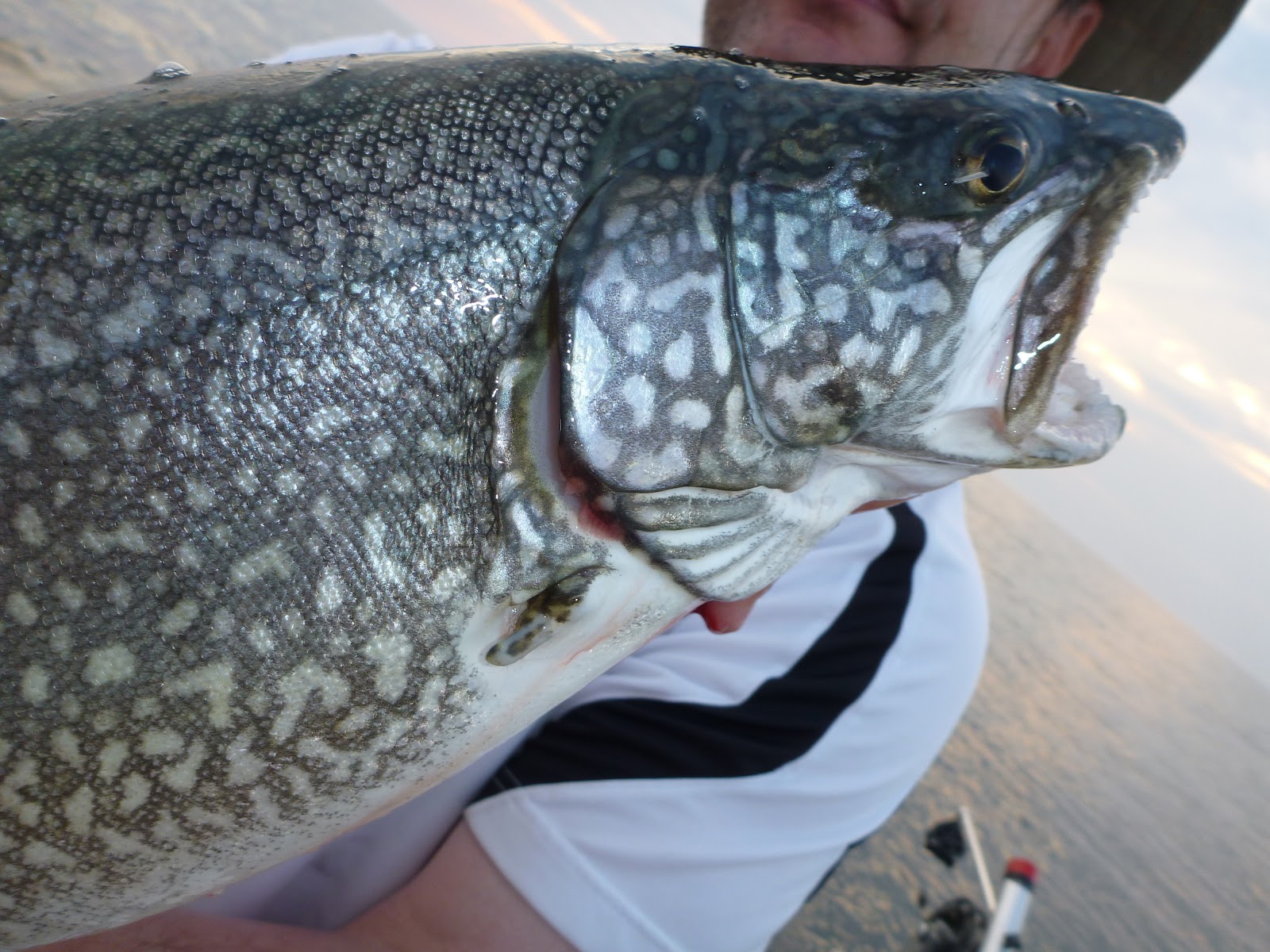
The fish took another break here, and our next flurry occurred in about 110 fow after 8 PM.  After changing the full-core's mixed veggie-type spoon to an old fashioned Black/Green/Glow, this rod awakened to a different type of strike; deliberate and sustained.  The fight was deep and bull-doggy.  I was guessing "laker", but I was surprised at the girth of this fish when she came aboard.  She'd been eating something!  We took a few moments for a photography session with this beautifully-marked fish, and even though there was still light, and perhaps the best fishing was yet to come, we decided to call it a night.  (Getting old and wise and content might be leading to reduced catches, but wise and content are not bad qualities.)
This laker was fat!

Beautifully marked lake char
We trolled towards port as I slowly pulled lines (of course, leaving the most hopeful rods out the longest.)  With a single line left in the water, the board on the 300-Copper line with the UV spoon got buried; I slipped the boat into neutral, and Katie quickly landed another king; this one was about 8 or 9 pounds.

We hadn't encountered many boats this evening, and when we returned to port, we discovered why; everybody was fishing well within 50 fow and into the channel.  They seemed to be having some success, too, as we saw a few nets fly as we picked our way in.  Surface water temps were 73 - 74 F, but it must have been a thin layer, and the fish were definitely "in."  But Katie and I agreed, this wasn't a pleasant place to fish; and we really couldn't have done too much better than we had.

But this trip wasn't so much about the fish as simply escaping town and getting out there, and sharing another Great Lakes trip with Katie.  She seems to enjoy the relaxed parts of this fishery, and she does a good job at the wheel, on the rod, and with the net.  We talked non-stop for well over 6 hours, shared a few laughs and lots of smiles, and returned home with new stories and experiences.  

Katie's aware that lots of fisheries offer "Grand Slams."  She's also aware that, while a real grand slam drives in four runs, many local fishing slams are for only three species; striper/blue/albie; snapper/grouper/mahi; bonefish/permit/tarpon; redfish/sea-trout/flounder; etc.  She refused to recognize our King/Steelie/Laker as a Grand Slam; but rather as a simple 3-Run Homer.  I can't argue with that logic, especially when there are still "ducks on the pond" in the form of cohos and browns.


Tuesday, July 3, 2012

Newman!


Newman!

How are you with the Rock Bass of your life?  I’ve led a tumultuous adult existence with them, and after 30 years of love and hate, maybe I’m approaching a peaceful acceptance of them.  How can a single species of panfish cause so much emotion?  Am I at risk of other panfish relationships?

I caught my first rock bass (Ambloplites rupestris) when I was 18 or 19.  Like many first timers, I had no idea what I’d just encountered.  I’d never seen anything like it before, and yet it was strangely familiar.  After a ferocious top-water strike, this denizen of the Mink Brook depths had come to hand fairly easily.

Rock Bass - from the web

I offer the following simply as an example of the dangers of a colloquial up-bringing.  I grew up in Little Rhodey, where there are no Ambloplites, and apparently we have no cause to discuss them or include them in the available fishing literature.  Here I was, a full-grown man, on course for degrees in zoology and aquatic ecology, and I couldn’t identify this fish.  Its head and fin structure indicated that it was a Centrarchid  (in the sunfish family.)  I knew we had Black Crappies in Rhode Island, but that there were White Crappies out there, elsewhere.  So I concluded, tentatively, that this was a White Crappie, but its girth suggested otherwise to me.  And so the next day I was in Dartmouth College’s Baker Tower stacks.  In pretty short order, I was able to identify my catch as a Rock Bass, for which the Connecticut River reportedly served as a sort of range boundary.  So not only had I captured a new species for me, I had tapped into one of the eastern-most populations. Surely these Rock Bass existed within 60 or 70 miles from my home; and yet they were entirely alien to me.  What else didn’t I know?  What else don’t I know?

Anyway, Rock Bass became a welcome addition to my New Hampshire-based college fishing.  Rarely did they plague me like perch sometimes would; their strikes were fun to detect, and often impressive on top; they were heavy enough to bend my rod, and all in all, they added to my experiences.  They weren’t smallmouths, but they helped pass the time between bass.  

Things changed, however, when I spent some time on Gull Lake in Michigan.  My key to success on this lake was locally trapped minnows, and these were seasonally scarce.  Here on Gull Lake, the likelihood of a Rock Bass strike became inversely proportional to the availability of such bait.  So when bait was running low, the rock bass would appear; and I could virtually guarantee that the day’s last fish would be a Rockie.

This phenomenon followed me to other lakes.  The early 90’s introduced me to Seinfeld!, and Rock Bass became my personal Newman!  Much like Seinfeld’s neighbor “Newman”, they were my omni-present, yet loathesome companion.  There were times when I really couldn’t get away from them.  Plus, they’re fat, goggle-eyed and a little ugly, too.  So Rockies became “Newmans” aboard my boat.

And yet there were plenty of times when Newman was endearing.  I’ll be honest, some of those Gull Lake rockies were fun to catch on ultra-light tackle; and they saved the day on my first trip to Gull Lake with my new Tracker boat in May, 1990.  While the Atlantic Salmon didn’t want to play that day, and it was way too windy to control the boat in most parts of the lake, an isolated early-season weed-bed seemed to hold every pre-spawn rock bass in the lake.  These were fun and big, and they provided the necessary diversion for me and a friend all afternoon.  I didn’t fish with this friend for many years (20?) there-after, but when we did hook up again, we both fondly recalled that day of quick action.  Newmans also saved a couple of days while fishing with kids, when nothing else would bite or the motor couldn’t get us safely across the lake.  We found them quickly, they were willing biters, and kids don’t care what kind of fish it is.  Parents-in-charge-of-the-trip probably shouldn’t care, either, but rather should make hay when the sun shines.  Finally, I recall a trip to Platte Lake, where, as always, the weather was off and as a result the bass fishing extremely difficult.  I know I trolled up a bunch of walleyes and a really nice pike that trip, but I most vividly recall a giant spawning rockie that eagerly accepted my tear-drop/wax worm combo.  What else could I say, even with gritted teeth, other than “Hello, Newman!”

Friday, June 29, 2012

Baker Lake Simplicity


I got  out on a weekday evening for the first time this summer and headed to Baker Lake with Dave C.  I haven’t fished much with Dave in the last few years because of family schedules, but he’s the last of my original Michigan fishing buddies, and pretty much always welcome aboard my boats.  (The other original buddies have simply moved away, it’s not like they’ve passed on or anything.)  He was atypically frazzled by the events of the work-day when I picked him up, and his fishing may have suffered from his various distractions, but by the end of the evening things had sorted themselves out; his factories were back in gear, his QA/QC issues were getting worked out, he’d caught a nice bass, and we’d shared a very pleasant evening of bassing on a pretty unique lake.

This was also the first trip of the year for Arracuda.  With a repaired bung hole, a new color Lowrance fish finder, and first-pull starts, it was a success on all fronts.

We were experiencing the leading edge of a strong warm front, and it was fairly hot, hazy and windy from the south.  Recorded water temps were 84 degrees F (decreasing to 82 F over the course of the evening.)  That’s pretty much our local summer max; I don’t recall recording consistently warmer temps in fishable waters before.

One of the beautiful qualities of fishing on Baker Lake is its simplicity.  Ringed by pads and slop, with very distinct drop-offs and basins; all of the bass I’ve ever caught here have come from the slop or the edge.  I suspect I’m overlooking some of the complexities; surely there are bass in the basin or way up in the slop and beyond into the swamp.  But I’ve not figured those out, and so my approach is simplified as I utilize what I know works here.  A frog, a senko, a worm or creature; usually the bass respond to at least one of these.

Having not been to Baker yet this season, and with limited time, I told Dave we’d just fish in areas where I’ve previously caught big fish.  We spent the evening fishing stretches of shoreline and slop where I’ve taken bass over 3 pounds previously.

I took a 1-pound bass up in the slop with a Spro frog pretty quickly.  That, combined with the active frog calls and occasional blow-ups, seduced Dave into using a frog for most of the rest of the evening.  Unfortunately, he never hooked up, but his use of the frog freed me for subsurface exploration.  All of our action until about 9:15 PM came on a simple, Texas-rigged black Powerworm; nothing fantastic, but several bass to barely legal size and two dogfish came aboard.

A puppy of a dogfish

I’d  never before seen a small dogfish in the wild!  From my aquarium experiences back in the 80’s, I know they’re wicked fast growers; and every dogfish I’ve encountered while fishing has been an adult of probably 7 pounds or more.  Tonight's were about 14 and 20 inches long.  They were also unique in that only one other time have I taken multiple dogfish in one trip; and they tripled the dogfish I’ve taken from this lake.  They’re welcome, any time.

As 9 PM approached, with the sun setting, the lake’s activity level perked up a bit and I started alternating a senko in with the worm.  The first legal bass of the evening came aboard, and the rest of our time was spent using these, pretty productively.  Along the edge of the main point separating the lake’s two largest lobes, we noticed that the lake bottom, usually covered with cabbage and milfoil here, was raised to just beneath the lake’s surface, and now covered with Chara and outboard scars.  I don’t really know the source of the gas or lifting force beneath the thick mat of weeds, but I do know that we took several bass, including a pair of solid 2+ pounders on senkos along the edge of this feature in our remaining time.  For all I know, most of the lake’s bass were residing under this raised, yet submerged, mat.  I’ll investigate more on future trips.

Baker Lake Bounty

With enough remaining twilight, we loaded the boat by 10 PM and enjoyed the fireflies on the ride home.

Thursday, June 28, 2012

Florida 2011


About a year ago, I had the good fortune of sharing 10 days or so with my family in Florida.  It wasn’t a “fishing vacation”, but we did get to share several days on the water.  Whether it was swimming from the beach, viewing Key Largo’s reefs and fishes through a glass-bottomed boat, snorkeling, hand-feeding marina tarpon, or Islamorada charter fishing; we played together (hard!), and collectively shared a bunch of cool experiences.  Each was better than I could have asked for, planned or expected.  I still day-dream of floating above the reefs in warm water, observing as many fish types and behaviors as possible.  I’m still astounded at the quality and variety of the reef habitats we accessed, the liveliness of the ocean regardless of where we were.  Barracuda, sea turtles, sharks, bait and predators; all there, readily available to our fairly casual observations.  I was both excited and yet fulfilled at their presence (I’ll admit it, I was geeked!) and I remain so, knowing of their continued presence.  In comparison, I fondly recall Marie’s bliss on the Fort Lauderdale beach with a slice of Cheesecake Factory cake, Katie’s pleasure at Harry Potter World, and Amy’s constant companionship and her pure joy in her family.  And of course, I remember the fishing.

Ooh..Barracuda!
Katie in Key Largo

Marie can appreciate Ft. Lauderdale!
All my girls

Our first fishing trip was scheduled for Tuesday morning.  The marine forecast was promising, but just about every day had featured some intense tropical rain storms.  So of course, I woke up early to the sound of thunder, and with a companion scheduled on another boat, I glumly watched a gray sunrise get obliterated by sheets of rain.  Later, we donned our gear (we may have been the only family at Hawk’s Key with full rain gear) and met Captain Joffrey at the dock. To my pleasant surprise, he put our comfort and enjoyment before Eagle Eye’s bottom line, and comparing schedules, we were able to re-book for Wednesday evening.  Captain Joffrey seemed excited by this prospect, as the snappers were reportedly spawning and he doesn’t get to do too much evening/off-hours fishing.  (He also probably didn’t want to fish in the rain.)  We left the dock with the gift of the prospect of more comfortable fishing, a hot breakfast, an open day of shopping and exploration, and (for me) another day to day-dream of the fish to come.

Wednesday morning we sailed aboard the vessel Blue and snorkeled a nearby reef.  Conditions weren’t perfect for snorkeling (cloudy and choppy), but visibility was still decent, and I was impressed by the predators.  Compared to what we saw in Key Largo, there were a lot more snappers, groupers and mackerel.  This session maintained my enthusiasm for The Keys.

Blue's navigation aid...nice!

Wednesday evening, we watched Joffrey and other boats’ mates clean a collection of snappers and amberjacks.  Some of the reef donkeys (AJs) were huge, and as we boarded Eagle Eye (a bit late because of all the fish cleaning and between-charter chores) in comfortable, but clouding, conditions, I hoped to share something really cool with my family.  I didn’t quite know what to expect; I’d never done this type of fishing.  But I was looking for something new, some beautiful fish, some slipping drags; and for the entire family to be involved and active in our pursuit.

After a short run in modest seas, we anchored in pretty shallow water (35 feet or so, still in patch reefs).  A couple of light spinners were broken out, an oatmeal and fish oil chum line established, and small cut baits were free-lined behind the boat.  A take was signaled by a jump in the line and increased speed of line loss; and hooks were set simply by flipping the bail and tightening up.  The girls caught on quickly, and a steady stream of fish started to come over the rail.  A little variety at first (needlefish, gray surgeon, white grunt), but then the targeted yellowtail snappers arrived; and we probably could have caught these all night.  Captain Joffrey offered the choice; more of this or the possibility of some bigger snapper offshore.  As a family we chose to prospect for bigger fish; and under decreasing light conditions (it was nearing sunset, and the clouds continued to thicken), we headed to an offshore, man-made reef in 240 fow.

Yellowtail!
Katie's enjoying the easy reef fishing.

This fishing was done with heavier conventional gear (braid to fluoro, with a 6 or 8 ounce sinker on a fish-finder rig), and the baits were live runners, snappers, pinfish and grunts.  As the boat was positioned and the gear prepared, the kids saw a fin slicing the surface of the water.  Shark or dolphin?  We’ll never know, as we didn’t get an identifying look.  Two baits were delivered to the bottom and reels held in free-spool.  In quick order, I was hooked up, and I was initially impressed.  This fish pulled!  After a few strong runs I got the fish turned and played it carefully to the boat.  Captain Joffrey reminded me to keep pressure on the fish and make time, because he was quite certain of the presence of sharks, and didn’t want to lose the catch to them.  Soon there-after, I was fairly stunned as I held my first mutton snapper; a high-teen beast that wouldn’t be matched.

First ever mutton snapper
Fish On! for Katie

Next Katie hooked up, and she couldn’t control it.  Was it a big AJ like we’d seen at the docks?  With Joffrey’s coaching she pressured the fish as much as she dared; and then was sharked.  This was the end of the action here, and as mate Brian re-rigged, we moved to a broken ship-wreck in about 150 fow.  The fishing here was pretty fast and furious; the bait of choice was a reverse-hooked, butterflied ballyhoo, and five more nice muttons came aboard.  At the height of the action, Joffrey and Brian engaged in a high-five as (name) struggled with her snapper.  Meanwhile, the clouds were probably thickening (but it was dark, so how would I know?), and the frequency of distant lightning increased.
As what I assumed to be the last fish of the evening was landed, a closer and more vivid lightning strike prompted Captain Joffrey to call it a night, and we pointed towards the Duck Key channel marker.  I was surprised to see more lightning across the Keys, Gulf-side.  I was enjoying myself, but I didn’t want to be trapped in an electric storm, and I certainly didn’t want that for my family.  This was a little too exciting for Amy; and Captain Joffrey’s quiet reminder to not touch any metal on the boat didn’t help.  He did a good job of getting us in quickly, negotiating some choppy seas and the marked channel. “ No Wake” requirements be damned, and the same to the  folks who are warm, dry and safe in their canal-side homes, and yet who might take offense at our speed.  Nevertheless, by the time Eagle Eye was docked, the electricity was dissipated and we were still dry.

Even the pros are enjoying this!
Marie and Mate Brian - all smiles

My mind a blur of yellowtails, muttons and sharks, my perspective undoubtedly skewed by the size of our muttons, amped up by electrical storms, and with the next day’s pelagic adventures just hours away, I showered and went to sleep.

In a blink I was up again, and Katie and I prepared to go offshore for mahi.  The weather matched the forecast (fine!) and fresh off the success of the previous night, we returned to the Eagle Eye for our morning departure.  Here we were met my Captain Jim, and he confirmed our desire to go offshore, but warned us that heavier seas and unseasonably poor dolphin fishing could change the day’s plans.  We agreed to warm up with some reef fishing and to take the day from there.

Eagle Eye, a 26-foot Regulator, ready to go

After a slightly longer initial run than the previous evening, we anchored at the edge of the reef in about 85 fow.  The same chumming tactics and light spinners were employed, but this time our 1/32-ounce chartreuse yellowtail jigs were tipped with frozen silversides.  The drifts were longer, and it took a while to get the bite going, but as the sun climbed we enjoyed steady action from larger yellowtail snappers (Captain Jim’s favorite!) and a variety of other fish, including remoras, bonitos, mangrove snappers, and the occasional, unstoppable mystery fish.  These were probably groupers dining on our hooked snappers, and some of these totally overmatch the tackle; but we were right on the verge of turning some of these, and I fought one for quite a while before it managed to rock up and cut me off.  While we didn’t catch any true “flag” yellowtails, we caught some quality ones to 18 inches or so; and these bigger snappers were worthy fish on this tackle.  Perhaps the fishing highlight of the morning was breaking off a fish while Katie struggled to subdue hers; and then watching Mate Daniel try to comically net her mangrove snapper with the bait net, for fear of breaking it off on the lift or swing into the boat.

Yellowtail
Surprise Mangrove

After a couple of hours of this, just as I was noticing the calming seas and brightening skies and starting to wonder about our offshore prospects, Captain Jim declared that it was time to give it a shot if we were willing; and we jumped at the chance.  The offshore target would be dolphin; but tuna, sailfish, wahoo and even raising marlin were possible.  This fishing would involve a lot of hunting; watching the seas and skies for weeds, rips or birds while running; quickly deploying a couple of plastic chugger baits on flat lines behind the boat and prospecting likely areas at about 8 knots.  Any action could keep us in an area; no action meant picking up lines and continuing the search.

On about the third set, the rod on my side of the boat jumped dramatically, and as I grabbed the rod and picked up some slack, a dolphinfish announced his presence with a high, iridescent jump.  He wasn’t big (somewhere between chicken and lifter?), but he was beautiful, and he fought like a true gamefish.  The mood on the boat shifted from heightened expectation to satiated relief; and with this small fish’s capture, I achieved some sort of bucket-list milestone. “ I gazed with wide wonder at the joy I had found” and at his beauty.  But the satiety and wonder faded with his color; and it was time for another!


He had come in as a single, with no apparent schoolmates, and so the search began anew.  Shortly, Katie’s rod jumped and bowed; the drag growled and now we were really mahi fishing!  This fish was as good as the first, plus!  He was big, he was determined, he was aerial.  He was yellow, he was green, he was blue.  When he came to the gaff, Katie’s smile said it all.  The Keys were only 20 miles away, but this was a separate world, and we were there, together!  It still seems inconceivable to me that we shared this and pulled it off with such good fortune. 


There was another, mid-size dolphin to be caught after a few more sets; I mostly remember the electric blue edging on his fins.  But Captain Jim had the good sense to save some time and baits for a couple of deep drops on the previous evening’s artificial reef in 240 fow.  I think the baits were blue runners and grunts, but it’s a blur, and in any case, they didn’t last long.  First drop to the bottom resulted in a quick strike for me, and I was tight to a fish with a much worse attitude than the muttons of the previous night.  This was fun!  And while the muttons are reportedly delicious (the source, I expect, of their popularity with the natives), I expressed my appreciation of the moment to Captain Jim.  Thinking "Amberjack", he replied that this fish wouldn't eat so well; but I didn't care.  We didn't know for sure what it was until it circled the boat, and I was pleased to see my first sizable Jack Crevalle.  His reputation had preceded him, and was well earned.  

With my "big' fish" in the boat and released, I thought it was pretty gutsy for the Eagle Eye crew to then suit up Katie with the fighting belt, and have her drop a single bait by herself.  The bait couldn't have been much more than halfway down before she got bit, tightened up and engaged in the fight to end all fights this day.  Her fish turned out to be an Amberjack, aka Reef Donkey of about 30 pounds. Not the giants that we had seen the night before, but still enough of a fish to make a grown man cry.

Our time was done; we rode smooth seas in under full power (for the first time all day).  Nice boat, nice tackle, nice fish, nice day; all serious understatements.  Marie and Amy were waiting for us at the dock, Captain Jim had a cold beer ready for me while he cleaned some of our fish, Katie and I were on seriously good terms; all was good with me.  The only way to make the day better was to take a pit stop, a shower, deliver our fish to Tom's Harbor House Restaurant, and enjoy our last evening at Hawk's Key.  Each was accomplished in quick succession.

Jack crevalle
Reef Donkey On!
Katie's largest fish yet - a Reef Donkey that could make a grown man cry!
Mahi and snapper prepared three ways; with sides!

Now, a year later, the fishing recollections are still with me, but they are not, perhaps, as strong as my memories of being in the water.  Perhaps that’s my natural element.  Neither are my fishing memories as strong as the images I retain of each of my girls at the beach, at the park, pool-side. Perhaps those are their natural elements.  Slightly different than mine, but openly shared, for which I’m thankful.

Near the end of our vacation, a cabbie in Fort Lauderdale offered to switch lives with me without hesitation.  He didn’t know my occupation, wealth status, politics or criminal record.  He simply knew automatically (just from my presence from out of town) that I had it good, that my life lacked many of his issues.  Just like I can’t imagine scratching out a living for my family as a service provider in a foreign country, he couldn’t imagine the ease and bliss of a family vacation, and all the factors that make one possible.  So yes, he had access to the Treasure Coast’s Gulf Stream, temperate weather and South Florida glitz; but not to my world of security, recreation, and love.  With a similar lack of hesitation, I declined his offer.

Monday, June 25, 2012

Win - Win - Win


DATE:             June 23, 2012
LOCATION:    Port Sheldon (Lake Michigan)
With:              Bruce, Jamie and Jayce Peters (Numenon)

TIME:             5:45 AM - Noon
HOURS:          6.3
WEATHER/CONDITIONS:  Clear and bright; warming; east winds 10 mph but diminishing

Shortly after last month’s trip out of Holland, Cal approached me about taking his brother Bruce and his nephew from Colorado out this weekend.   Bruce was offering to “hire” me, and while I said I couldn’t do that, I’d gladly take them out if the weather was OK, and if they felt like matching Cal’s donation to our office Christmas Charities, that would be great.   As the weekend approached, the forecast looked promising; and by Noon on Friday, plans were set to meet at the Port Sheldon ramp at 5:30 Saturday AM.  During lunch, I picked up some herring strips and surprisingly promising reports from The Outdoorsman in Jenison, and I prepared the boat and tackle with high anticipation.

I arrived fifteen minutes early and was surprised at the level of activity at the ramp.  Obviously, people were expecting to catch some fish, and more folks seem to feel like they have some disposable income than the last few years.  It was the busiest (non-Reeds Lake) ramp I’ve experienced in quite a while.  Bruce, his son James, and his grandson Jayce were right on time, and by 5:45 AM we were motoring out of Pigeon Lake to Lake Michigan.  There was a bit more wind than expected, but conditions were still very comfortable and fishable, and this easterly wind calmed over the course of the day.

Radio chatter and boat traffic confirmed the previous day’s reports; fish were expected between 80 and 120 fow.  Surface water temps were 65, compared to the previous day’s 63 degrees F.  I shut down in about 72 fow, south of port and away from others, and we quickly marked bait and fish. I set our 9-rod spread with anticipation of some quick sunrise action, but surprisingly we were already in over 120 fow without a bite by the time I got everything (2 dipseys, 3 riggers, 4 boards) out.  While I was targeting salmon, I hedged my bets with 5-color and high divers set with proven steelhead baits.  I also went with all lures (no herring) to start, hoping to take advantage of aggressive biters early on.

Taking control of the boat and turning east back into shallower water, the negative radio talk started to accumulate.  Some were struggling and seemed surprised.  I noted the difficulty of controlling the boat in the modest waves and it’s crab-walking progress; currents seemed to be an issue.  Working these out, the high diver set 145 back on 3 jumped in 105 fow; a silver bullet was in the air, and James brought a beautiful, approximate 7-pound steelie into the boat.  Shortly there-after, this same rod went in 86 fow, and Bruce brought in a twin trout.  Jayce declined any action (it turned out he was afraid of dropping the big rods while fighting the big fish), but he did enjoy looking in the cooler at the fish, which were much larger versions of the Colorado mountain trout he was familiar with.  Turning south to maintain depth, this rod went a third time, but the drive-by didn’t connect.  So by 7:30 AM or so, I felt like we were on the verge of figuring something out and on our way to a really good day.

Bruce with the day's first steelie

James and Jayce


But like on so many previous days, a switch flipped; and other than a brief connection on the full core with a green/orange Moonshine lure in 110 fow at about 8:30 AM, we had no other bites.  We continued to mark fish, and we ground out our time in the “known” and comfortable water.  In the meantime, crowds thinned as boats either went in or out to deeper water; but all in all, we were stuck in this unproductive water and never encountered biting salmon.  Even herring failed to entice any bites.  Our last trolling pass was easterly all the way into 60 fow or so; and we were done for the day, back at the launch by Noon.  I expressed my hope for a more active day, but we all recognized that fishing isn’t necessarily catching.  And all in all, both trips combined, Bruce experienced “average” fishing aboard Numenon; just with a high degree of variance.

Jayce
Other boats coming in at the same time had similar catches.  I think I should have gone out deeper and found some cooler water; I was possibly too comfortable with the sonar marks and the previous day’s reports.  I need to do something about my Fish Hawk temperature probe, and be able to trust it.  This was a classic day where I could have eliminated unproductive water, handled and interpreted the currents, and maybe done a bit better.  But overall, maybe it was a Win-Win-Win day; I filled my boat and got a chance to practice my fishing and attitude improvement programs; Bruce, James and Jayce got out on the water under beautiful conditions and caught a couple of “World Class” rainbow trout; and their donation to our Christmas Charities was more than pocket change, at least in my experience.

Steelies love divers and Fuzzy Bear spoons; this combo
took both steelies and 3 of the 4 hits for the day