Thursday, September 13, 2012

Names


Names

What’s in a name?  It depends.  A simple word can beautifully describe an emergency adult undergarment, yet be a horrible moniker for your boat.  Names can be useful, descriptive, deceptive, mistaken, just plain fun, or just plain wrong.  Providing a meaningful name to each of her bass became as important to my youngest last trip as actually catching them; sometimes I can see that she's truly a chip off this old block. 

Just about everybody names their boat.  Mine’s Numenon. By way of explanation, see my original post, or just accept it as a type of mayfly.  But how about tow vehicles?  I don’t even want to think about my original couple of towers, but by 1992 or so I had accumulated enough wealth to get a 1992 Chevy Work P/U Truck, and that simple truck served me dependably until my family outgrew it.  What it lacked in flash and good looks, it made up for in dependability, sensibility, and Mid-west charm.  This truck became “Bob Dole”, and like him, lasted for near forever.  Bob Dole never let me down, but he never exactly excited anybody.

More kids means the need for more room, so I moved on to a 1997 GMC Yukon.  I’ll never again own a nicer truck for towing.  Roomy, smooth, leather and air; enough power and braking ability to tow anything without breaking a sweat.  So big, so white, so superior… I’m embarrassed to say that she became “White Sup******”.  But like all other White Sup*********s, she was at heart really crappy, caused lots of worry and problems, didn’t accomplish much and didn’t last very long.

So now I’m in a burgundy 2006 Toyota 4Runner.  She hasn’t exerted her personality to date, other than being everything I expected.  Simply based on her color, she’s become “Ron Burgundy” of Anchorman fame.  But as I’m composing this, I realize that “Anchorman” is a much better boat name; Ron Burgundy only superficially describes this truck, and so she’s being re-named “Bob”, simply because Al Yankovic has reminded me in his song Bob, that “A Toyota’s a Toyota!”

In addition to “Anchorman”, boat names in my future might include “Bunker Boy”, “Squid Hound”, or “Ichthusiast”.  There’s a zillion other possibilities, and I often capture these on sticky notes; but each of the above conveys, in some manner, my passions.  Of course, I can always keep “Merely Phlegm”, “Phlogiston”, and “MILF-OIL” in my back pocket.

My boat prior to Numenon was the “Mrs. Paul” based on my perception that she was a major provider of food fish, and that her catches greatly affected (indeed controlled!) market prices.  My current small tin boat is “Arracuda” based on the fact that the “B” has broken off her manufacturer’s name plate, and also based on the availability of a really cool guitar riff (courtesy of Heart) whenever she comes up in thought or conversation.  Originally I thought she’d be “On F’Eyre” in homage to a steelheading mentor, but when a name sticks, you can’t mess with it.


Of course, boats and trucks cost a lot of money, and it might just be more affordable or economically sensible to just have a few more kids.  Social Science will be served when I name my future twins “Erudite and Troglodyte”, or “Dexter and Sinister”, and I’ve always wanted a little girl named “Clytemnestra”, “Penelope”, or “Persephone”.

Wednesday, September 12, 2012

The Gulf Stream


The Gulf Stream

This has to be a short entry, because I’m no expert on The Gulf Stream.  I’ve only spent a few days out there, but from what I’ve experienced, it might represent my special wilderness.  I’m fully alive out there.  Driven by global-scale planetary energy balances, timeless, tireless  and seemingly endless, virtually untouched by humans (except for fish-concentrating detritus!), the Gulf Stream’s clear, pure  purple water is accompanied by a stiff easterly breeze on the best days, delivering possibly the cleanest air in North America.  No wonder it’s so invigorating!

Gulf Stream, January 2010.  Clean air, clean water, Fish On!

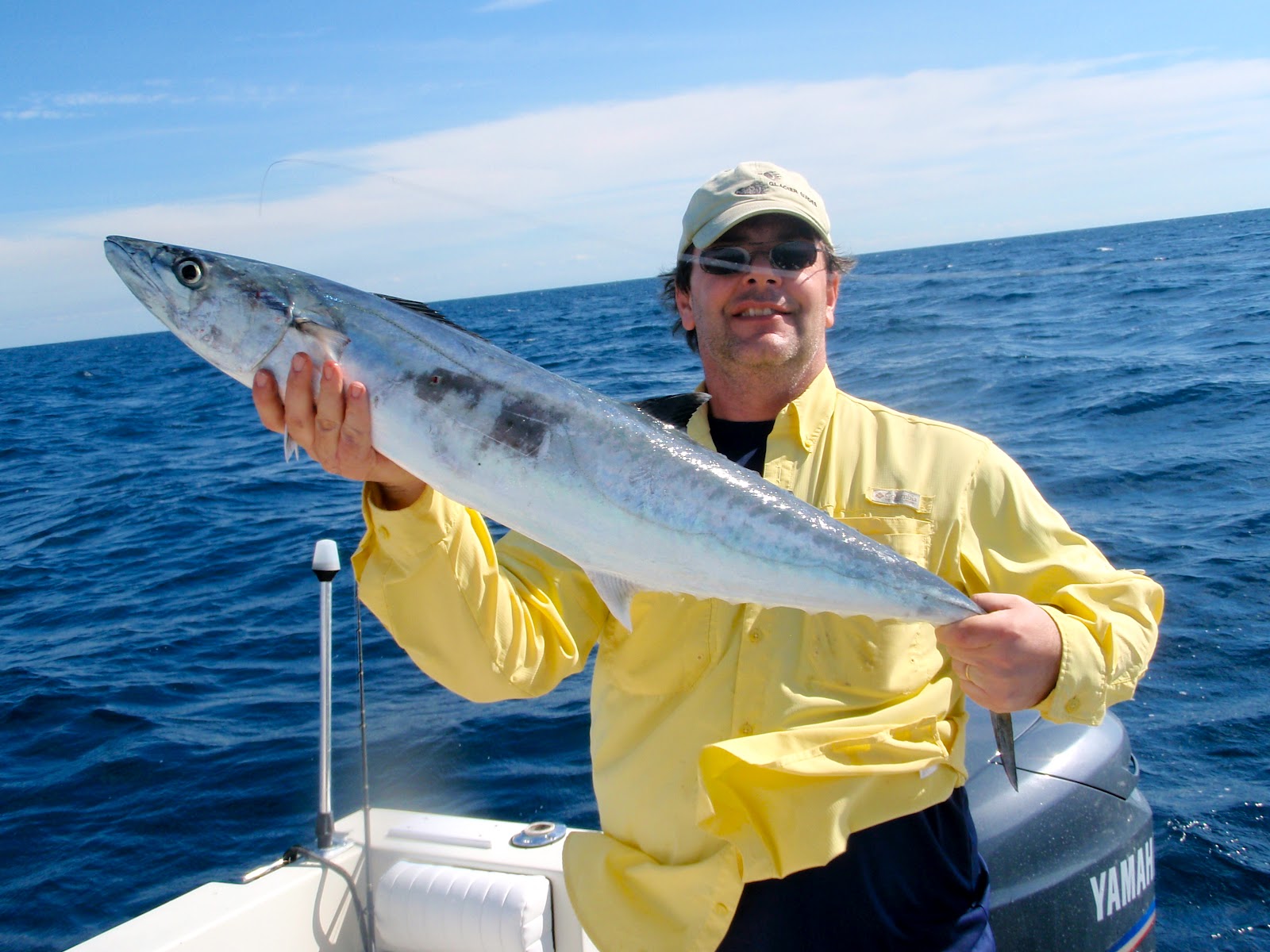
And then there are the fish.  Flying fish are simply cool.  To me eye, they’re more bug or bird than fish, because I see them in flight.  They’re fun to watch, fascinating to contemplate, and their appearance means predators below!  I’ve not had any encounters with tuna yet, but those predators could also be (among others), dolphin fish (mahi), king mackerel, or sailfish.  The kings have provided most of my action; they’re sizeable, speedy and flashy, and they’ve provided a few awesomely explosive surface hits on free lines and kite baits.  But between their impressive dentiture and with big-eyed scad going for $8 or $10 a piece, so far they’ve been mostly an expensive distraction.  I’ve gotten just enough taste of mahi (literally) to know that I’m not done with them.  They’ve been largely absent or hit-and-miss in my limited time, and so I know I haven’t gotten my chance to fully appreciate them, yet.  Regardless, unless I’m down to my very last bait in a sailfish tournament, kings and mahi are welcome to crash my spread, anytime.

Kite-crashing King

And then there are the sailfish, the primary target of most of my offshore sessions.  Sailfish might be my perfect game fish.  Sails are large surface feeders that can be matched to fairly light tackle of your choice.  They’re seasonably abundant, and not too far offshore of Florida’s Treasure Coast.  Sails are uniquely beautiful, and they provide an aerial fight combined with astonishing speed and power.  Finally, they’re very releasable.   Other than for the issue of accessibility, what could be better?  Perhaps a marlin, simply based on size, but when does the balance of the experience tip away from fun, and toward work?

Grey-hounding sailfish on light spinning gear - off the kite!

First sailfish release

My pursuit of sailfish seems realistic (if only very occasional).  I’d love to take Numenon to Palm Beach and give it a try some winter.  Common sense, time and money all indicate that this probably won’t happen, but I think she deserves a shot at a fish as long as her transom.  I know I’ve got many of the bases covered between my sets of striper and salmon gear.  I can see which rod and reel combos would go where, different variations of home-made teasers running off one downrigger, live baits in the Bait Saver flow-through bait well.  I even know what Numenon feels like at an 8-knot troll with chuggers, because I’ve practiced on Whitefish Lake.  I’m ready.  She’s ready.

Sunday, September 9, 2012

Paid-for Fishing


Paid-for Fishing

There are certain things a guy probably shouldn’t pay for, but I guess I’ve decided that it’s OK to hire a fishing guide.   A quick inventory of my paid-for fishing history indicates about 3 weeks on the water, or approximately 0.1% of my life.  I apologize to my family for the expense incurred for the couple of dozen trips I’ve booked, but I have to admit that this 0.1% looms large for me.  In addition to my personal expense account, this time is overly represented in my photo history, memories, and impact on my fishing.

Let me also say that my primary goal for any day I’ve booked is to learn something, so that I’m better prepared to take on the fishery (or some parallel situation) by myself.  So while I’m enjoying the moment, you can be certain that I’m considering future trips and applications at the same time.  My other goal is for my guide to have the best day of his season.  This would indicate that the fishing was pretty good, but as importantly that we clicked as a team, I was prepared for the trip, and I did as much of the fishing as possible.  I also expect that certain fishing opportunities are revealed for the subset of customers that are ready for them, and I wouldn’t want to miss out on those. 

I’ve booked guides for Florida bass, White River (Arkansas) trout, inland stripers, salt-water stripers, blue-water fishing in Florida, and for simple pond fishing.  We’ve always caught fish, and I’ve always gotten something out of the day, but the fishing has rarely been fantastic.  After all, fishing results always average out; it can’t be great every day.  But along the way, I have collected personal bests for bluegills, warmouth sunfish, stripers, sailfish, kingfish, mahi, various snappers and Jack Crevalle.  I’ve also gone eyeball-to-eyeball with a fantastically large brown trout, whipped an 8-foot alligator on bass gear, and been keyed into some fisheries for even better fishing by myself, later.  I also know I’ve only gotten a taste of certain fisheries, and I hope to return to these again.  So the stripers and blue-water fish had best watch out; it’s only a matter of my time and money.  But overall, I’ve been exposed to new species, techniques and tackle, and I feel confident that I’ve gotten what I’ve paid for.

Of course, I’ve worked for that value.  I’ve tried to take care in selecting guides (thank you, Internet and e-mail!), I’ve thought about what I want out of the trip and have conveyed this to the guide; and I’ve learned as much as possible (prior to the trip) about how we’re likely to fish.  Usually when I step on the boat, the actual fishing is somewhat familiar.  Whether it’s my first time free–lining baits for yellowtails, trolling chuggers for mahi, or down-lining for stripers, I’ve been ready to step right into the fishing and produce/enjoy the experience right away.  My preparations before the trips more than paid for themselves in terms of each day’s experience.

A couple of times, plans and/or guides have changed at the last minute based on weather, schedules, etc.  While these trips have been fun, productive and exciting, I can’t say that I’ve appreciated them as much.  So I may have participated in an epic catch of mutton snappers off The Keys, and we did troll up six sails on frozen ballyhoo in 10-foot seas; but I can’t really brag about these trips or extrapolate on them because I was as much spectator as participant.  And other than not losing too many fish, I wasn’t much of a contributor to these trips. I’m not complaining, I’m just saying that these trips haven’t had the impact of some others, simply because my lack of preparation for these particular situations reduced the intensity of my participation in the entire experience.

One aspect of my guides’ collective approach to the day’s fishing that I’ve noticed is simplicity.  Most basically have had one proven system/approach for the day, and many have relied on high quality, fresh bait.  Some of the funnest days have incorporated the food chain; whether it’s been sabiki-mackerel-striper, waxie-sculpin-brown, or shrimp-runner-kingfish, making bait, and then converting that bait into the day’s quarry, is both fun and satisfying.  The simplicity of the offered approach shortens the client’s learning curve and probably results in better catches.  It also relieves the boat from carrying lots of extra gear; less stuff equals more space and greater comfort and success.

Hopefully I’m learning these lessons.  My own fishing here in Michigan rarely utilizes bait and I always have four back-up plans and the gear to support them.   In practice, I’m a pretty versatile, multi-species fisherman, but I’m not a master of any given technique.  I suspect mastery will require me to purge Numenon of all the extraneous gear and focus on the task at hand.  This may or may not happen; I’m trying to have fun, and I have access to many quality fisheries.  Many of these opportunities are open only briefly, and I’ve gotten into the productive habit of “gettin’ while the gettin’s good!”  So the gear is in continual rotation, and I may pound a species for a trip or two, and then not revisit them for quite a while.

I suspect that one should generally do what the guide says.  He does, after all, want you to catch fish.  He can also help with some bad habits you might have developed, so take advantage of his advice, learn and improve!  Take advantage of the guide’s patience to ask questions and to instill confidence that the bites will come.  Think about how you’ll utilize the knowledge/techniques you’re using in your own fishing, and if you have an idea about how your own techniques would work, talk about these.  I’m always trying to cross-reference fisheries and applicable techniques, and the most common response I get from guides regarding techniques is something along the lines of…”Should work.  Don’t see why not.  We just don’t do that around here.”  But if it’s fun, I think it should be on the list of techniques employed.

So I will kite-fish for stripers!  It will probably be a lot of extra work, and it probably won’t result in extra fish, but I imagine that the strikes might be pretty epic.  I also think that the stripers will have a hard time ignoring a mackerel or pogie pinned to the surface in just the right setting.  On a more mundane level, I expect I’ll incorporate planer boards and down-riggers into my saltwater striper fishing; not really ground-breaking stuff, but I just don’t see folks utilizing these tools in the waters I fish.  I may find out why when I try; but I may cash in on what the locals are missing.

I’d also like to thank one guide for the concept of a “Jewish Christmas”.  During a lull in the kingfish bite he told the story of his best ever day guiding.  As I remember it, his client took multiple sails, a wahoo, and a blue marlin.  It was Christmas Day, but not a holiday for his Jewish client.  I take the concept as kind of like an elevated Busman’s Holiday, but I’m always looking for that best, most memorable experience. I wish every day was my Jewish Christmas.  Anyway, can I recommend that you fish when you can, enjoy the bounty provided by whatever force you choose to believe in, and treat every fishing day like it’s a holiday?

Wednesday, September 5, 2012

Prizes!

Prizes!


I’m fairly amazed at the motivational influence of an offered prize.  We recently demonstrated this with the promise of smart tablet devices for the members of the winning “team” among the young swimmers on our local age-group swim team.  The assigned task was to raise funds through swimming; and the kids out-did themselves and more than doubled our normal fund-raising efforts.  Those few tablets were an excellent investment for the club.  I shouldn’t be surprised at this outcome; I once heard an interview on NPR with a former professional party-thrower for a well-known brand of alcohol.  This pro, in his experience, admitted that there are few boundaries to what a young adult will NOT do for a free T-shirt.  Are T-shirts all that motivating?  Not for me; but prizes are, generally.

I’m subject to this, too.  A favorite movie of mine is A Christmas Story, and I can relate to the father.  He’s distracted and consumed by his puzzles and sweepstakes, but when his “Fragile” prize arrives, you can feel his palpable excitement.  Whatever this prize is, it seems like it will have to be a let-down; but in fact, it’s even better than imagined!  It’s glorious!  


From the web!

And so I recently dove into Maine’s Casco Bay and swam out to claim “My Prize” of a free-floating lobster buoy.  Okay, when I captured it, it wasn’t quite as cool as it had previously seemed.  But it did offer a bit of momentary fun and the promise of being an appropriate commemorative trophy.  For the same reasons I’m currently participating in On the Water’s “Striper Cup”.  I want My Prize, and irrationally (given my location in Michigan for the remainder of the striper season, to say nothing of my inexperience or access to fish, even when I’m in New England), I think I can (will?) win!  My twin entries in the photo contest are of barely eligible fish, and my photography is nothing special.  And yet I’m driven to follow their published results and trust in the “chance” part of the contest to overcome any of my fishing and photographic deficiencies.

Yea!  Broken Lobster Pot Buoy!

Casco Bay - 36 inches, caught and released

Narragansett Bay - 36 inches, caught and released

The Feng Shui god(s) must cringe at my home’s opening hallway, but by gosh, I’m proud of my two salmon tournament victories, and what better place is there to display my plaques?  I’ll admit, they’re not attractive; they’re not great decorations, and they’re probably undeserving of their occupancy of this place in my home.  But they are a reminder that, in a small inconsequential way, I was special a couple of times; my Partner Charlie Sheen and I were "Winning!" and I like the reminders and all the associated fond memories.  I think it’s the potential for such future reminders, as much as the immediate fun, that drives my quest for a prize. 

Rationally, I know that one shouldn’t invest more into an endeavor than one can probably get in return.   So it doesn’t make a lot of sense for me to care about my results in the Striper Cup or to fish in too many tournaments.  But I have to recognize the alluring power of The Traveling Office Trophy, or the pride I feel in having won the 2001 Grand River Hand-line Contest.  Last year's fine 4-pound smallmouth would be just a regular memory for me, except it secured the Office Trophy for 2011's largest smallmouth bass.  This year's species is brown trout, and I remember April's 6-pounder (which just happens to lead the 2012 contest) more vividly and more fondly than a typical April Brown.  And why would I recall the specific fishing conditions and close calls I endured (suffered?) in a hand-line contest over a decade ago?  Because these little, meaningless pieces of plastic are motivating, and maybe I tried a little harder than usual. But the effort is not directed at the prize itself, but rather for the promise of crisp memories of the associated events.

Ned Flanders represents Fishing Superiority in my office.

This hand-lining hobo has resided in my office for over a decade.


Sunday, September 2, 2012

That Fine Line


One pre-dawn morning earlier this season, I approached a blinking red light.  My mind (admittedly, probably on auto-pilot) interpreted it as a four-way stop, and so even though I saw the car approaching from my left, having stopped, I went to accelerate through the intersection.  Then something momentarily clicked for me, I braked hard, and the car continued just past my truck’s nose at full speed.  That car had the right-of-way with just a blinking yellow caution light.   I had both almost wrongfully caused, and narrowly avoided, a nasty T-bone accident.  I had nearly shared a very bad day with a stranger, through no fault of their own.  Instead, I proceeded to pick up my fishing partners for the day, and we caught some very nice salmon, including a pair of personal bests.  The day as a whole was a resounding success.  But this near-incident served as my most recent pointed reminder of the very fine line that, during every outing, separates success from failure, safety from disaster, good memories from bad.  I try to be mindful of that line, respect it, and stay on the right side of it, but I doubt I’ll ever fully understand its nature.

Early in my salmon fishing “career”, I shared a trip to a more northerly Lake Michigan port.  To date, my experience had been at more southerly ports.  For the most part, these are structure-less, and the salmon are nomads, chasing bait in pockets of water with preferred water temperatures.  A basic key to success at these southern Lake Michigan ports is to present you lures at the intersection of bait and temperature; the salmon should be there.   Up north, the drop-off and other lake bottom structures become more prominent and often dominate the fishing strategies.  Success here is often based on staying in touch with fish that are relating to the drop-off, associated currents, etc., and folks can get fairly aggressive in asserting their rights to maintain relative position while trolling along the break.  On this particular trip, we were having some success in 110 feet of water, as were others.  While Lake Michigan is a big body of water, it’s not big enough to accommodate multiple boats in the same spot, and the circumstances of boat traffic forced us into shallower water.  We struggled against the change in location as long as we could, but when the downrigger balls started bouncing on the break’s bottom, it was time to change our presentation, if only to protect our gear.  But before I could raise the first cannonball, a downrigger rod fired.  In short succession the other rigger and the dipsey were attacked, and we had our first ever triple-header.  Needless to say, we stayed in shallow, banged bottom, and continued the catching; nice fish that we would have missed had we not been forced to cross the line and change locations. 

The drowned river mouths of West Michigan are robust fisheries, and they’re especially well known for trophy walleye.  This is mostly a night bite, and some of our local trophy hunters seem to think that unnatural lights put off the bite; and I’ve learned that many of them choose not to use their required navigational lights when fishing for walleyes.   I learned this the almost-hard way, by nearly plowing through an unlighted walleye boat in the middle of a basin while running to my first bass spot of the morning.  This incident was way too close for comfort, and it changed the way I approach fishing in the dark.  I also learned that it’s not too infrequent of an occurrence. 

What agent of luck provided the margin by which I missed that boat?  I’m sure it’s the same as that which determined all the close foul balls, contested third strikes, blown umpire calls, and the narrow wins and losses of my baseball youth.  The stakes seem a little higher with hockey; a fraction of an inch up or to the side and I could have lost my vision to pucks at least twice.  Instead I simply bled a lot, got some stitches, and endured a couple of epic black eyes.  No real damage was incurred, and yet I was super close on multiple occasions of suffering life-altering injuries.  Let's not even talk about bikes or cars.  I’m sure it’s just physics, but beyond the mechanics of a given situation, how can one not wonder at the magnitude of the underlying dumb luck, especially when there’s risk of great loss?

I don’t want to get too deep here; fishing’s about fun. So of course we should remind ourselves to be careful, to act responsibly, and to avoid problems.  We should be thankful for our good fortunes, and we should learn from our close calls.  We can manage our luck to a certain extent, but I still wonder at some of the factors behind our catches.  When I stop for gas on the way to the ramp; wait for somebody at the launch; tend to bodily needs; or navigate around a flock of water-fowl; do these acts alter our results?  Do they change our timing on the water, and present our baits to different (bigger/smaller) fish?   I’d like to think that the effect of these incidents is small, compared to the bigger decisions of fishing location, lure presentation, and so forth.  Thinking about these little effects is probably like trying to balance your household budget by controlling butter purchases; too ineffectual and misguided in the main.  And yet, how can I not think that at least some of the individual fish I’ve encountered have been a result of these small forces, or that I’ve not missed out on other outrageous fish by a similarly fine line?

An honest Lake Michigan Tyee Salmon - 32.5 pounds


Saturday, September 1, 2012

Skillfully Fishing the Baltimore Orioles’ Way


I’ve been at this fishing thing for about 40 years, and in addition to the pictures, mounts and memories, I’ve accumulated quite an assortment of skills.  Some were handed down, some have been eagerly sought and developed through practice, and others have just kind of shown up. Many might prove to be worthless in other endeavors, but I’d like to think that others are transferrable to other aspects of my life.  Maybe they even help me be more effective, or at least more interesting to those around me.  Memorizing Knot Wars bracket results (and all the knots!) might be overkill, but being able to join two lines of unequal diameter, reliably, could be an important life skill.   There’s no real value to Latinizing your entomology (unless you enjoy it!), but not being afraid during a blanket mayfly hatch, or recognizing a termite, is useful.  Playing “Angling Editor” with popular media portrayals of fishing and fishing gear will get you nothing but frustration, but having a general awareness of how to hold a tool, or of fugu poisoning and Ciguatera, are good things.  And I feel comfortable in stating that basic first aid and swimming skills, as well as safe navigation, docking, trailering, etc.,  are all benefits to personal longevity and society. 

Now, there’s nothing like fishing to identify a deficiency in your skill set.  Examples here are almost too obvious to list, and everybody’s fish story includes (at least the threatened appearance of) one of these.  Bad casts, broken knots, failed equipment, stalled motors, overturned canoes; all are easy fodder.  But most situations in life are much more subtle than these examples, so how about choosing to use Trilene XL instead of XT and dealing with the consequences?  Or braid instead of mono?  Nickel instead of pure silver plate? Suspending or sinking?  Blue flake instead of red flake?  Each of these choices could go either way, depending on the situation; your skill set’s deficient until you’ve developed informed opinions on these (and a limitless number of other) factors, can defend your choices, and then cash in with proper execution.

Similarly, there’s nothing like sharing your boat with kids or non-fishers to high-light your skills.  Without the crutch of a proven fishing partner, it’s up to oneself to get things done.  Meanwhile, your guests are likely to be undoing your fishing chores faster than you can keep up.   They’re probably introducing new, unanticipated variables into the boat’s equation-of-the-day while they’re at it, and any fishing success on this trip may depend on your preparation, your coaching, and your patience.  But when things come together, you’ll seem like a minor deity, or at least a magician, to those not in the know.  This is even more true when the events of the day (good or bad) are taken in stride.

Having just landed a fine salmon aboard Numenon, an acquaintance recently asked, “How did (I) learn to do all this?”  He was bewildered by the apparent emptiness of the lake, the sieve of lines behind the boat, and the different lures and presentations, especially in contrast to our calm (and successful!) execution of an announced fishing plan.  A lot of what takes place on my boat just feels innate at this point, so I had to think for a moment.  But I quickly realized that it’s always best to be shown how to do it (properly) in person.  I’ve been fortunate to have had some good fishing buddies and guides who have shared their experience with me.  Next best is to read about fishing or watch a video; I enjoy both and have spent more than my share of time doing so.  Of course, you have to fish; and often enough to make as many mistakes as possible.  Pay attention at each step; learn what you can from each mistake; eliminate or at least minimize their re-occurrence; have fun along the way; and before you know it, you’re proficient!

I work in a field with generally broad objectives.  As the field has matured, it has spawned a multitude of specific programs and requirements.  It’s not uncommon at all to feel lost in the forest because of all the darn trees in one’s way.  But there’s a path out of the forest; and I’ve likened this path to the organizational philosophy of the Baltimore Orioles (at least, back in their good old days.)  The Orioles were known for their discipline, and for not beating themselves.  They were fundamentally sound, executed plays seemingly at will, and were opportunistic.  They were the Pro’s pros.  How do you get to play baseball The Orioles’ Way?  According to Cal Ripken, Sr. (the coach, not the player), you do “2,000,000 little things the right way, and the big things work themselves out.”  It turns out that I’ve adopted this philosophy at work and on my boat!

(Historical note; While my Red Sox lost last night (to the A's!) by a score of 20-2, the newly resurgent Orioles defeated the Yankees to close within a couple of games of the Division lead.  The O's have been  a solid club for a year now, and so maybe their good old days are back.)

Wednesday, August 29, 2012

Catch and Release

When I was a kid and somebody actually caught a fish, the standard practice among my peers of the time was to stomp on the fish and immobilize it underfoot; probe, twist and pull as necessary; and possibly "chimprovise" and use a tool such as a stick to provide extra reach or leverage.  Hook extracted, the fish may have been strung up, released or purposelessly tossed up on shore.  I learned pretty early on that pre-snelled hooks could simply be snipped off in the fish and my "leader" extended with pre-tied loop-to-loop knots.  This made for easy releases, but I wasn't a 10-year-old made out of money, and so that wasn't a practical long-term solution.  We didn't catch a lot of fish, and some were kept for the table, but the carnage still piled up.  Not like the frog and bird hauls that could be accumulated quickly with a BB gun (largely the interest of another set of kids), but I'm sure we weren't exactly fostering our fisheries.

Now "The Pond" had bass, and they're fun to catch, so-called "sport" fish.  They're also not so spikey, have big mouths, and provide handy grips with their rubbery, sandy lips.  They were available in limited numbers, I had a long future ahead of me, and they taste pretty much like swamp gas.  So they made perfect candidates with which to practice catch and release.  I'm glad I caught onto this, because I recycled the bass in The Pond, which I otherwise could have easily over-fished.  As it worked out, I caught many of them multiple times.  While there were others that I encountered less frequently, these were large enough to be interesting, and they were released in the hope they'd re-appear later, and larger.  They often did, until the winterkill of about 1981 - 1982, when The Pond revealed them for the last time, along with several GIANT bass that had quietly eluded me for years.  The mystery of those few giants instilled new interest in me for these habitats, the fish, and the sport itself.

Early season catchin' and releasin'

Striped bass have many of these same attributes, and I'd like to say that I can see for myself that catch and release practices on these fish are effective.  I've caught previously tagged and released bass, and just this season I'd say that about 10% of my captured stripers showed obvious signs of having been previously hooked and released.  With such a vast ocean, the stripers' big migrations, so many places to hide and my puny efforts in their capture; if I can detect some evidence of catch and release effectiveness...imagine the importance of these practices on smaller waters.  Perhaps the primary reason I've stayed with fishing is that I released those Pond bass; and was able to catch them again.  Let's face it, catching fish is more engaging than simply fishing, especially for a child.  If I'd caught these fish just once, perhaps I'd have moved on to other activities out of boredom.  A basic tenet of environmental protection now is re-use of materials; I was doing that with my Pond long ago, unwittingly; but effectively and convincingly.

Stripers are made for catch-and-release.  Note the circle hook!

I'm not against legally harvesting fish for the table or as trophies, but I usually don't.  I don't necessarily enjoy eating them, and I get too much of a kick from reviving a worthy opponent, feeling his recovery, and witnessing him swimming away.  I'm motivated, too, by the possibility of catching him again.  Or perhaps another kid will catch my fish, and I'll catch somebody else's generous releases.  And while I have bittersweet feelings about running away from active fish, there have been times when I've been more concerned about limiting my catch, as opposed to catching my limit, just because of possible mortality associated with unsuccessful releases.  Not all fish are as amenable to catch and release as my bass.  These fish have been left alone, rather than risking unwanted mortality.

I'm convinced, catch and release is important for certain game fisheries.  I'll respect your informed opinions, but please consider the use of circle hooks with your bait, follow all regulations, make good use of the fish you keep, and take a kid like me (or at least like I was) fishing with you every so often.

36 inches of striper swimming away - Thanks, Captain Patterson!